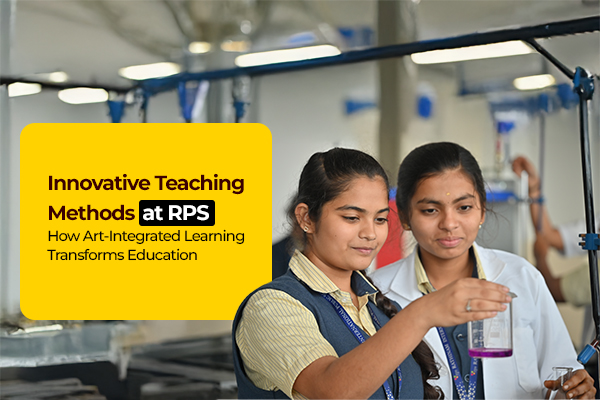
The learning at RPS is never about classes and books because it is a process of immersion, where the combination of creativity, knowledge and education will become an enjoyable experience. As the world of education is continuously evolving, RPS is not lagging behind and introduces teaching methods provoking the desire to explore, encouraging some discovery and leveraging the abilities of every child.
It is because it has a good background in the CBSE curriculum that the school is no longer limited to the traditional methods of learning, but can create learning experiences that are meaningful, memorable as well as transformational.
RPS Philosophy: Learning Multisensory
RPS does not consider learning to be uni-sensory. The child pours not just learning by reading but sights, hears, touches, moves and expresses.
The school understands that students have a different learning style. This diversity requires flexible and changing approaches that are not as rigid as patterns of teaching.
“At RPS, every child becomes a creator of their own future”
The Art-Integrated Learning: The core of the Innovation in RPS.
Art-integrated learning is an idea of utilizing art as neither a stand-alone, but a strategy to study, articulate and explore scholarly ideas.
Art can be in various forms, be it in colors, theatre, dance, music or craft, but an avenue through which the children can identify themselves emotionally and intellectually as they learn.
Significance of Art-Integrated Learning.
Artistic learning does encourage critical thinking, liberation of questioning and assertiveness. It transforms multifaceted problems to learning units.
Benefits at a Glance
- Develops creativity and imagination.
- Improves intellectual, critical and problem-solving skills.
- Acquires self-confidence in self-expression.
- Makes the learning process enjoyable and stress free.
- Using art integrated learning in classrooms.
How RPS Implements Art-Integrated Learning in Classrooms
Graphical Art to Unambiguous Ideas.
The illustrations, schemes, mind maps and innovative models help the students to simplify the complicated issues and understand them.
For example:
- Diagrammatic storytelling of science.
- Model-making for geography
- Examples of language learning.
Music-Driven Learning
Songs, rhythms and musical patterns help the student to remember the formulas, grammatical and chronological rules. Music makes academics more fun and emotionally attached.
Theatre and Role Play
The recreations of history, drama based activities and story performing help the students to explore empathy and communication in real life and perspective of real life.
Dance and Movement
Kinesthetic is one form of learning that has an advantage to children who learn best by moving. It creates the rhythm, the coordination and the sensitivity of the body-language.
Interdisciplinary Projects
Art is a fusion of science, mathematics, literature and social studies and it has an overall view of concepts as offered to the students.
The Technology of Enhancing Learning in Arts
RPS uses digital devices to complement the methods based on art. The teaching of the students on various levels will be guaranteed through the use of smart boards, audio-visual resources and animation tools and interactive simulations.
Impacts of Art Integrated Learning
Innovative Teaching which is driven by art creates confident, expressive and emotionally intelligent students. Effective problem solving skills, memory and communication skills are also acquired by learners.
“Learning at RPS: creative, confident, and future-ready.”
Conclusion
At RPS, teaching does not entail the amount of information that the teacher can impart on the students but rather it is about making the young minds explore, dream and be creative. It is all interactive, lively and meaningful as it is the learning process in which art is a part of it.
By being innovative, technologically advanced and professionally oriented, RPS continues to generate competent minds and extroverted students who are future ready.
FAQs
1. What is Art-integrated learning at RPS?
It is a combination of subject matter and the visual arts, music, theatre, dance and craft so as to enable the student to build the concepts in a creative way.
2. What impacts an art-integrated learning on academic performance?
It promotes thoughts through the employment of pictures, gestures and creative display which fosters memory, encourages comprehension and enhances long term retention of the subject.
3. Does RPS use technology to support learning based on art?
Yes. RPS integrates smartboards, digital art systems, virtual labs and online interactive platforms to increase creativity and increase understanding of concepts through multi-sensory learning.
4. But what about students having other learning styles?
RPS provides visual, auditory, kinesthetic and activity based learning opportunities to every child either the observer, performer, creator and explorer.
5. What are the competencies that the students learn using the art of integrated learning?
Students develop the ability to be creative, think critically, have emotional intelligence, communicate, gain confidence and team building skills.
Blog crafted by Ghowthami M, Content Developer,
Rankyouhigher, Coimbatore.