
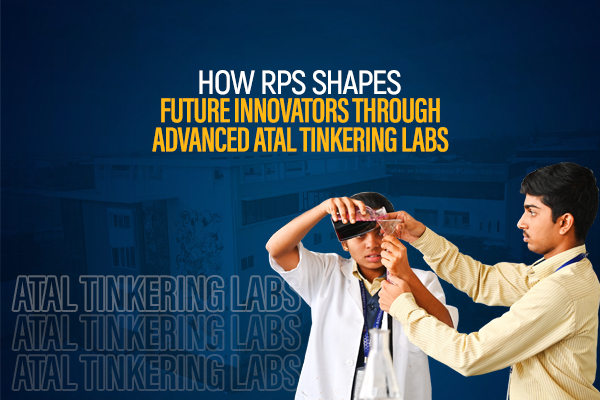
Apprenticing Innovation with Atal Tinkering Laboratories
In the modern world that is moving very fast, education does not just entail textbooks and classroom learning anymore. The schools should turn into centers of innovations – areas where young minds should be inspired to think, create, design and experiment. This philosophy is central in our learning ecosystem at RPS.
By incorporating the Atal Tinkering Lab (ATL) program in our education system, RPS will enable students to be inquisitive, imaginative and innovative.
The Vision Behind ATL at RPS
Atal Tinkering Lab is a flagship program of the Atal Innovation Mission (AIM) in NITI Aayog of the Government of India. Having the goal of sparking curiosity in children and their creativity, ATL is constructed as an environment in which students learn by experience as opposed to being taught.
A Place Where Ideas Become Reality
Robotics kits, open-source microcontrollers, sensors, 3D printers, science modules, mechanical tools and DIY equipment are among the state-of-the-art instruments that ATL at RPS has.
In this case, students will be encouraged to ask.
- How does this work?
- Why does this happen?
- What am I going to construct so as to fix this issue?
It is a question based model that instills confidence and makes the learners active thinkers.
Innovation and Exploration Learning.
Hands-On STEM Exposure
Students are able to have real life exposure to STEM (Science, Technology, Engineering and Mathematics) in an interactive and practical setting through ATL. Rather than simply reading about theories of science, they construct models, experiment with theories and refine notions.
Design Thinking and Problem-Solving
RPS also incorporates design mindset learning into laboratory and classroom actions. Learners are taught the ability to solve issues, generate ideas and develop solutions, and revise them, which are some of the skills that leading innovators across the world apply.
Physical Computing & Robotics
Having access to open-source controllers and robotics kits, students learn:
- Circuit building
- Coding logic
- Automation
- Building smart devices
This instills analytical minds and calculational abilities early in life.
Why ATL at RPS Makes Future Innovators
In RPS we reinforce the vision of youthful leaders by our learning culture, which integrates formal education, creativity, and exploration.
Stimulating Curiosity at an Early Age
Children are inquisitive in nature. RPS provides them with the means and the space to explore their curiosity productively by:
- DIY science experiments
- Group innovation projects
- Competitive challenges
- Technology-based activities
Collaboration and Teamwork
ATL promotes collective innovation activities. Students learn the value of:
- Working as a team
- Sharing ideas
- Leadership
- Communication
These are the skills that are needed in contemporary careers.
Ways that RPS incorporates ATL into Everyday Learning
ATL is not a stand-alone lab at RPS but it is interwoven into the culture of learning.
Project-Based Support
The teachers match the subject concepts to ATL activities. For example:
- Circuit-building explanations of physics.
- Math through 3D modeling
- Coding microcontrollers Computer science.
Mentorship and Guidance
ATL-trained facilitators, robotics instructors and STEM teachers help students to create innovative projects and attend science fairs and other competitions on national and international levels.
RPS – A School where Innovation is a Habit
.
The educational achievement at RPS goes beyond the academic scores. We strive to make students prepared to lead, innovate and mold the future.
Digital tools and activity-based approach combined with ATL usage in our current infrastructure make RPS one of the most powerful ecosystems of school education innovation. Here, students learn to dream, to design and to innovate.RPS is the place where the inventors of the future start their life.
FAQs
1. So what is the Atal Tinkering Lab at RPS?
ATL is an innovation studio in which students can play with tools such as robotics kit, sensor, microcontroller, 3D printer, and science modules to learn the concepts of STEM, as well as to apply the theory practically.
2. What is the starting class of students who may utilize the ATL?
Middle school students and older actively engage in ATL activities, but younger children receive exposure to these activities on an age-based guided basis.
3. Do ATL activities have an impact on normal academics?
No. ATL improves academic learning. Students acquire knowledge in subjects since they can put into practice the lessons in the classroom through carrying out experiments.
4. Do teachers have training in the field of robotics and STEM?
Yes. RPS has certified ATL coordinators, STEM teachers and trained faculty that mentor students in innovative projects and competitions.
5. What is the role of ATL in the future career of my child?
Developed by ATL, design thinking, coding, robotics knowledge, problem-solving, and innovation are sought skills in the workforce.
Blog crafted by Ghowthami M, Content Developer,
Rankyouhigher, Coimbatore.